This column is a regular sharing of the family, work, and community perspective of Rick Platt, President and CEO of the Heath-Newark-Licking County Port Authority.
Showing posts with label government. Show all posts
Monday, February 12, 2018
More Than Talking About Infrastructure
The President mentioned it briefly in the State of the Union. More mention comes today.
The Washington Post previews the $1.5 trillion infrastructure plan with a piece that has a bias expecting there to be more talk than walk on the topic.
Here's hoping we are more than talking about infrastructure.
Keywords:
government,
infrastructure
Wednesday, April 26, 2017
Ohio Economy Can Benefit From Manufacturing-Focused Tax Reform
Federal tax reform is buzzing on Capitol Hill. The shape it takes is still to be seen, but one thing is clear for Ohioans. Reform that benefits U.S. manufacturing is reform that will benefit all of Ohio’s economy.
With the U.S. continuing to lead the world in manufacturing production and our GDP competitors seeing a decline in working-age population, the opportunity to grow manufacturing in the U.S. is strong right now. Experts have said that the Midwest and Ohio are poised to take advantage of that growth and outpace the rest of the U.S. in GDP growth.
From my position working on the front lines of industrial development, I see our strongest manufacturers are those which have an international perspective and seek to compete globally. Plus, international companies are, increasingly, looking at investment in the U.S. They are getting the message: Make it here to sell it here.
However, export-driven U.S. companies are paying taxes both in the U.S. and abroad. Their foreign competitors often do not. It’s as if there was a penalty for “Made in America” products.
Leveling the playing field with fair trade and fair tax policies should be a part of tax reform. A new analysis from the Tax Foundation shows that the “Brady Blueprint” tax reform proposal would create more than 64,000 new full time jobs in the state of Ohio alone.
The American Made Coalition is an advocate for tax reform that includes some notable members with a strong Ohio presence. Boeing, GE, and United Technologies are a part of an aerospace supply chain in Ohio that supports more than 2% of our state's Gross Domestic Product. Ohio is Boeing’s #1 supplier state. Thus, Ohioans’ jobs, more than those of any other state, are dependent on the success of exports by Boeing and GE.
Ohio has an opportunity to grow its manufacturing base. Now’s the time. Good policy can take our economy from good to great.
----------------------
This column also has been submitted as an op-ed to The Advocate and Columbus Business First.
Keywords:
Boeing,
government
Friday, January 27, 2017
Be Thankful Your Building Wasn't Built in 1876
"It is not the critic who counts; not the man who points out how the strong man stumbles, or where the doer of deeds could have done them better. The credit belongs to the man who is actually in the arena..." -- Theodore Roosevelt
This quote came to mind during a recent tour of the Licking County Courthouse renovation project in Newark. The Licking County Commissioners have boldly undertaken a project to renovate the 19th Century courthouse on the square in downtown Newark. It's an undertaking not made for armchair quarterbacks or sideline critics. It's an all-in endeavor.
This is the 1876 courthouse a few years back.
Ohio's county seats have lost a few of these beauties over the years. Licking County is lucky to still have this 140+ year old iconic building around.
The cupula/clock tower portion of the building looks like it could be stone. It's not. It's a metal frame with sheet metal and ornate sheet metal pieces attached.
The dormer level is also mostly metal, not stone.
Early inspections didn't reveal just how badly the metal had eroded. Besides being coated with lead paint, the cupula was one direct wind hit away from being a disaster. It was a hidden mess.
That beautiful top to the building is not much more than a big old tin can.
And the County Commissioners opted to stop kicking that can down the road.
This is one of the new, metal dormers being installed. Even up close they look like stone. This dormer is being designed with modern technologies and tooled with modern capabilities that will restore it to 1876 and last decades ahead.
County Commissioners Duane Flowers and Tim Bubb led the tour to show off the progress. It gave visual learners like myself a true sense of the scope of the problems. And the solutions.
Local contractor Robertson Construction is leading the team.
From a greater distance than this picture, the public sees the belltower portion encased in scaffolding and draped in plastic. What's inside is a hollowed-out shell being rebuilt.
The tour gave us views that only birds and drones normally get to see.
This crew won't ever forget the tour.
We can't wait to see the final product later this year either.
Some will marvel at the price.
Some will marvel at how much it may look the same when it's done.
Some will marvel about something with some other tinge of negativity attached.
The men in the arena will know what they did was the sort of preventative maintenance that preserved an iconic building for yet-unborn generations.
The critics should just be thankful that their building wasn't built in 1876.
Keywords:
government,
history,
Licking County
Wednesday, July 9, 2014
The Personal Side of Trinkets
In my office, I keep a collection of trinkets collected over a 25+ year career in development. Every trinket has a story.
Two trinkets came from my Dad. The button was something he used during his time at the Ohio Department of Transportation (ODOT). During his five-year tenure there, he was a bit of a bull in a china shop and the buttons were his attempt at breaking the bureaucracy a bit.
When he left in 1996, the going away gift from the sign shop was a bigger version of his bureaucracy-busting message. When he passed away in 2004, I got both.
So, imagine my glee when I visited the ODOT headquarters yesterday for a meeting and what should I see? One of the ODOT people was wearing a well-worn version of the button around his name tag.
It brought a smile to my face. Sometimes it's personal, not business.
Keywords:
family,
government,
Ohio
Wednesday, June 11, 2014
On What Planet Are They Operating?
Even if we were on Pluto, our 45-day permit process took 474 days to complete with word of final approval yesterday. That's 10 1/2 times longer than the advertised time frame, even in Pluto days.
So, though I joke that some federal and state agencies are operating on a different planet when it comes to meeting time frames, there's no known planet where the U.S. Army Corps of Engineers taking 3,032 days to conclude a 45-day permit process is on time.
Yes, 3,032 days to complete a 45-day permit process is mind boggling to contemplate.
On Earth, if our permit were a child, it would be a third grader at 8 years, 3 months, and 21 days.
Even on Mars, the permit would be getting ready for preschool at 4 years and 3 months old.
To be fair, we concluded the permit itself over three years ago. However, we agreed to monitoring of the on-site wetlands spawned by the permit. That five-year process that was satisfied in four years took over seven years to get final word.
So, on what planet are they operating? No known planet in our galaxy.
So, though I joke that some federal and state agencies are operating on a different planet when it comes to meeting time frames, there's no known planet where the U.S. Army Corps of Engineers taking 3,032 days to conclude a 45-day permit process is on time.
Yes, 3,032 days to complete a 45-day permit process is mind boggling to contemplate.
On Earth, if our permit were a child, it would be a third grader at 8 years, 3 months, and 21 days.
Even on Mars, the permit would be getting ready for preschool at 4 years and 3 months old.
To be fair, we concluded the permit itself over three years ago. However, we agreed to monitoring of the on-site wetlands spawned by the permit. That five-year process that was satisfied in four years took over seven years to get final word.
So, on what planet are they operating? No known planet in our galaxy.
Keywords:
government,
humor,
property management
Tuesday, January 28, 2014
State of The Union: Buzz Words Watch List
"China is no longer the world’s number one place to invest; America is." That's a great line and sounds like one from an economic development sales guy. But, after all, that's one of the jobs of the President in a global economy.
This is my annual analysis of the State of the Union Address of the President.
For the first few minutes of the 2014 State of the Union Address of President Obama, I thought I was listening to a summary of Joel Kotkin's writings or, even, some of the points long-made in this blog about policies that take advantage of America's advantages.
Then, I heard even more policy statements with a great ring to them:
- Tax reform that makes onshoring of manufacturing easier
- Infrastructure investments that prepare for the future
- Energy independence that includes natural gas, including incentives for CNG fueling stations
- Business-sought immigration reform
- A STEM education focus
- Workforce training reforms
It's too bad this wasn't the speech at the start of 2013 instead. Regrettably, election years are not the years when these policies get done.
I counted one mention of Ohio (actually Youngstown) and five mentions of the word manufacturing, a pace that does not match his re-election year shout outs to the State and the industry sector, but still ranks higher than his early years in office.
Cathy McMorris Rodgers' Republican address had just one manufacturing reference. Skills training and immigration reform had good rings to them though. I wish she had focused on this topic to find common ground and to help elevate this issue to the agenda.
In the end, this was an event that can't expect to have made much difference going forward. I hope I'm wrong.
Keywords:
economic development,
government,
manufacturing,
politics,
STEM,
workforce development
Wednesday, August 21, 2013
Red Tape, Harder Than Asphalt
This was a little sad to read, but it might be true.
Forbes' columnist Tim Worstall wrote a piece today that pointed out the progress that is being made, notably by Google, with driverless car technology in the United States. He bemoaned the reasons that it still may be a while before we all get to ride in one had more to do with red tape than with technology or asphalt.
Worstall opines, "It’s a common enough theme around here (Forbes) that regulation is the major brake on economic development at present."
Red Tape. Harder than asphalt.
Keywords:
driverless car,
government
Tuesday, July 16, 2013
My Ancestors Land Went So Highways Could Be Built
Yesterday, I took a pragmatic stance on eminent domain. No one is "for" eminent domain, but pretty much all of us, if we are being pragmatic, know we need it.
Economically, we all have benefited in our nation for three generations from having highways upon which to drive. Our economic system has benefited from having them. We, frankly, take them for granted.
Everyone who drives or has ever driven on a highway or eaten food that is delivered via a highway, has benefited from having such a mode of transportation.
I'm not sure, even, the Amish could claim they don't benefit, at least indirectly, from this form of transportation.
My family has seen land it once owned given up for such a public good. I have proof of that. Here's just two of several such examples.
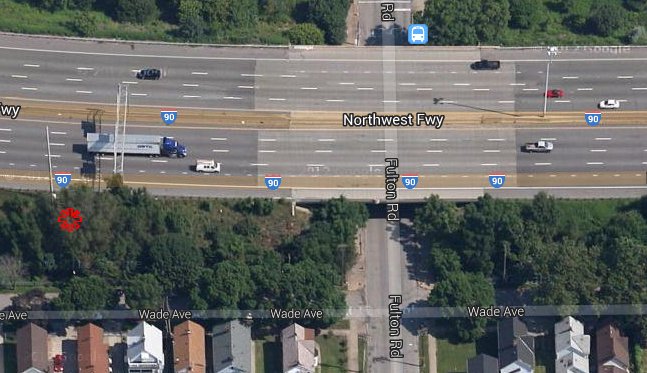
My great grandfather's former home in Cleveland, circa 1899, is now right of way for Interstate 90 in that city.
The Dayton neighborhood where the first two generations of one side of my family lived after coming here from Germany in the mid 19th Century is now under U.S. Route 35.
Now, I don't know whether eminent domain took their homes while they were still residents, but there's no doubt the property that once held their homes was taken for highway projects.
I'm sure this is probably the case, pragmatically, in many families.
Keywords:
government,
highway,
pragmatic
Thursday, May 2, 2013
Testimony on Increasing User Fees to Fund Development, Infrastructure
I testified at two public hearings conducted by the Licking County Board of Commissioners as they consider increasing user fees on conveyance of real estate and on vehicle licensing. Here's what I said:
The second floor at The Works contains so much history. It also contains proof that the people of Licking County have long understood the strong link between transportation infrastructure, economic development, and jobs. Proving that point is that the voters of Licking County in the mid-19th-century paid for the railroad connections that made Newark and Licking county the nexus of the Ohio River and Lake Erie.
It was user fees that helped pay for our canals, our
railroads, and our highways that have formed the basis for growth and
development in Licking County for the last 200 years. Imagine if our forefathers hadn’t invited and
attracted those investments in the past.
How much different, for the worse, would our economy be if we had not
seen these past investments ever happen here?
Fast forward. Now, in
2013, we find ourselves in a global competition for jobs that requires us to
reinvest in our infrastructure and to gear up for a stronger effort in economic
development. We don’t have to go far, though,
to see that we are at risk of losing ground.
Muskingum County gives land away to attract jobs. There are some years where Perry County has
spent more general fund dollars on economic development than we have. Fairfield County has combined resources and
devoted more funding to marketing in one year than we have in the last 10 years
combined.
Once ahead of others, we now risk falling behind unless we
act to give a more solid financial footing to the already-successful efforts of
the County-Chamber-Port Authority development partnership--Grow Licking County. Time spent trolling for dollars can instead
be spent attracting new capital investment and the jobs that come with it.
And while a modest increase in the conveyance fee for sale of real estate is only part of the equation, these investments will indeed go a long way in leveling the economic development playing field and bringing future growth opportunities, and with that job opportunities, to Licking County.
I urge the Board of Commissioners to approve the request for
a conveyance fee dedicated to economic development. I also support a permissive tax increase for
infrastructure improvements. These two
user fees are both necessary to keep Licking County progressing forward.
Keywords:
government,
Grow Licking County,
Licking County
Wednesday, April 10, 2013
Stimulus Act Lessons Before Our Eyes

The 2009 Federal stimulus program is still being spent. Here's a bird's eye view of Ohio's second largest "stimulus" project, the rebuilding of I-71 in downtown Cleveland near Progressive Field.
The largest one, the Nelsonville Bypass, is also still under construction. So, obviously, the impact was not economically stimulating when it was most needed.
Sadly, no one has indicated any industrial parks are accessible off of either of the top two projects so the projects' stimulus future is debatable too. Where's the future growth capacity?
What are the lessons learned from Ohio's top two projects?
Should there ever be another stimulus, the stimulation of manufacturing industrial growth should be a key part of the stimulus criteria. Speed to market should be too.
No one (at least not me) debates the need for these two projects. However, the concept of growth should be foremost in a stimulus package. Grow the economy first and the income is more likely there in the future for these "fix it" projects.
The catch phrase: Grow it first. Fix it second.
Keywords:
government,
highway,
manufacturing,
recovery
Thursday, April 4, 2013
Preparing For a Manufacturing Resurgence
If we could just tweak a few policy things, the U.S. economy could add 3.7 million jobs. Manufacturing is the key.
That's the Twitteresque (meaning less than 140 characters with room for a link) version of an Aspen Institute report titled The Manufacturing Resurgence: What It Could Mean For the U.S. Economy.
It's a must read.
The report models out a "plausible resurgence scenario" for U.S. manufacturing and what it could mean for the U.S. economy as a whole. The results are music to the ears of everyone who cares about manufacturing but should be to everyone. Everyone.
A summary of the report by Ideas Lab indicates these tidbits by the Year 2025:
How do we get there?
The Ideas Lab folks summed up the policy changes that could help bring about that resurgence versus maintaining the status quo. Here's the list:
That's really not a hard list.
Trade agreements that bring fair trade make sense.
If government stays out of the way, the energy boom will sustain itself and the resurgence of manufacturing is a spark to improve the electric grid.
Regulatory reform? No better time for that than a lameduck Presidential adminstration.
Who doesn't see the value of improving STEM education? We have to change attitudes, though, and that means embracing manufacturing.
Taxes and research funding are more difficult to tackle, probably, but that's all a matter of priority investing. There are times our policy makers have been able to figure that out.
Let's do it!
Keywords:
economy,
government,
manufacturing,
STEM
Wednesday, March 20, 2013
D.C. Day By The Numbers
Eight hours in to our day when this photo was taken, we still hadn't seen a soul from Capitol Hill.
Yet, by the time we were headed back, we had seen all 16 Ohio Congressional District offices, the White House, and both Ohio Senator's offices. Three members of Congress--Pat Tiberi, Steve Stivers, and Bill Johnson--personally took the time to listen and engage in a productive dialog with our contingent.
And what a contingent it was!
40 community leaders from among elected officials and business people joined in a chorus of support for the Aerospace Center. Combined those leaders committed over 900 man hours to telling our story.
Impressive numbers. Impressive day.
Keywords:
Aerospace Center,
government,
Licking County,
politics,
Port Authority
Tuesday, February 12, 2013
POTUS SOTU 2013
My observations from watching the State of the Union tonight:

MANUFACTURING
I heard manufacturing mentioned more times than I expected. This small, symbolic word count gesture matters. Seven mentions is better than none.
The talk of a generic policy to support manufacturing got one of a very few bipartisan standing ovations. That's a positive sign too.
Actions? It's time for a national manufacturing policy.

INFRASTRUCTURE
$50 billion for highway funding may sound good on the surface, but "fix it first" is a phrase that, at least in Ohio, has meant to exclude economy-expanding, capacity-growing suburban highway projects. The nation needs a balance of infrastructure projects dealing with maintenance alongside those in areas where growth can be accommodated and facilitated. "Grow it too" should be the added catch phrase.

ENERGY EFFICIENCY
Energy efficiency was one of the buzz phrases too. However, the federal government should not be involved in setting standards for private, commercial buildings' energy efficiency. These policies and programs, even in private hands, tend to be urban-biased, i.e. LEED certifications. I don't trust that federally-led ones would be less so.

TECHNICAL EDUCATION
STEM education efforts to match high school education with business needs was good bully pulpit language. A challenge put to keep college costs down certainly has a nice ring to it too.

MANUFACTURING
I heard manufacturing mentioned more times than I expected. This small, symbolic word count gesture matters. Seven mentions is better than none.
The talk of a generic policy to support manufacturing got one of a very few bipartisan standing ovations. That's a positive sign too.
Actions? It's time for a national manufacturing policy.

$50 billion for highway funding may sound good on the surface, but "fix it first" is a phrase that, at least in Ohio, has meant to exclude economy-expanding, capacity-growing suburban highway projects. The nation needs a balance of infrastructure projects dealing with maintenance alongside those in areas where growth can be accommodated and facilitated. "Grow it too" should be the added catch phrase.

Energy efficiency was one of the buzz phrases too. However, the federal government should not be involved in setting standards for private, commercial buildings' energy efficiency. These policies and programs, even in private hands, tend to be urban-biased, i.e. LEED certifications. I don't trust that federally-led ones would be less so.

STEM education efforts to match high school education with business needs was good bully pulpit language. A challenge put to keep college costs down certainly has a nice ring to it too.
Keywords:
energy,
government,
highway,
manufacturing,
politics,
STEM,
workforce development
Monday, February 11, 2013
Manufacturing Task Force Report: Embrace Manufacturing
The final report of the 21st Century Manufacturing Task Force, a committee of the Ohio House of Representatives, was published last week. It's worth a look if for no other reason than the bipartisan committee's report was unanimously approved.
Workforce development was, rightly, the first report item. "A properly educated and well-trained workforce is critically important to the long-term well-being of manufacturing in our state." Action items included encouraging the "use of virtual-reality training devices."
Energy was second. The link between energy costs and the success of manufacturing is strong.
Regulations, tax structure, trade, and transportation round out the rest of the ordered list with a handful of other items that follow.
All the language in the report, essentially, adds up to recognizing one key thing: The Ohio General Assembly needs to embrace manufacturing.
That's all they really needed to conclude.
Keywords:
government,
manufacturing,
Ohio
Friday, February 1, 2013
The Geography of Manufacturing: The Lessons
The U.S. Department of Commerce report "The Geographic Concentration of Manufacturing Across the United States" makes three key points:
1. The national economy continues to rely on manufacturing and 25% of the nation's GDP growth in the past three years came from the manufacturing sector alone.
2. Yet where that growth comes from is heavily concentrated in regions of the country, particularly the Midwest, and in states, like Ohio.
3. That growth is also unequal within states. The data shows manufacturing concentrating outside of metropolitan areas and urban counties.
So, what do we do with this knowledge? Here's my two main thoughts:
1. Keep the Spotlight On Manufacturing. Manufacturing enjoyed a spotlight in 2012 unlike any it had seen in decades. Yet, time will tell whether that spotlight came because of it's resurgence and boosting of the national economy or came for purely political reasons as the Presidential election campaign was heavily-concentrated on manufacturing-oriented Ohio.
The 2012 State of the Union address mentioned manufacturing 15 times. The Inaugural mentions totaled zero. That's a potentially bad sign of things to come.
NAM President Jay Timmons said he saw it as his job to hold the winner of the Presidential election accountable for promises about manufacturing. That's a necessary first step in ensuring that the "m" word doesn't disappear from the vernacular as the geographical reasons to care went away for a few years.
Manufacturing needs to capitalize on the spotlight, whether its more for its role in the national economy or for geographic political ones, and keep the issue top of mind in Washington. Because manufacturing is located, unevenly, around the country, that challenge is that much harder.
There has to be no let up, particularly by leaders in the manufacturing-concentrated areas.
2. Halt the Urban vs. Suburban Approach to Policy. We can grow the national economy with a focus on manufacturing and that growth benefits the nation as a whole. However, as the DOC report shows, there is an unevenness to where manufacturing is located even within states.
Politically, it would appear that geography, both nationally and within states, tends to favor turning a blind eye to manufacturing. The urban, media centers are not where manufacturing is located. It's too often out of sight, out of mind.
The way states like Ohio devote their resources for building new highways vs. redoing ones is a prime example. It's an easy catch phrase from urban-biased lobbying groups to say "fix it first" but that approach only causes a fight over a ever-shrinking pool of highway funds. Big, expensive re-do's get prioritized higher than forward-thinking, capacity-building highway projects outside of the metro areas. New capacity generates more highway funding revenue.
Instead, policy needs to strike a balance. Funds need to be ensured to go to building new capacity where the capacity to grow the economy exists too. Build interchanges where manufacturing is located and will use them. Add highway lanes where freight corridors get opened up and along where industrial parks are located.
Too many groups exist with the sole purpose of lobbying for urban interests at the expense of suburban ones. That so-called "smart growth" way of thinking needs to be halted that sees lobbyists fighting for a bigger piece of a shrinking pie approach. Rather, policy makers need to favor the balanced, overall one of fighting to grow the pie so everyone gets a bigger piece.
Bottom line: The evidence is clear and this DOC report enforces it. The future of the nation, and Ohio, rests on the success of manufacturing and that's in the suburbs.
Keywords:
government,
highway,
manufacturing,
Ohio,
smart growth,
suburbs
Wednesday, January 23, 2013
Liking My Tax Bill
![]() |
| The distribution of my 2013 property tax bill. |
Everyone complains about taxes. I'm smiling at my 2013 Licking County property tax bill, though.
It was my pleasure to help pass a Park District Levy that supports maintenance of our parks, paths, and trails in Licking County. For that, I'm paying a measly $14.62 a year in taxes.
I voted for it and I'm happy to pay it. It's a good investment.
I'm especially happy, though, that, due to natural growth in property values in Licking County and the subsequent readjustment of rates, my property taxes went down.
Yes, down.
So, despite the levying of a whole new tax to preserve our parks, paths, and trails, I'm paying less.
That's a reason to like my tax bill for sure.
It's also worth noting that my Newark, Ohio property tax rate is adjusted to less than 50 mills. That's not even 50% of the state average tax rate in Ohio. Then, consider Ohio's rate is way, way below many states in the Union.
Everything's relative. There's another reason to like my tax bill.
Keywords:
government
Monday, December 31, 2012
Don't Fret The Cliff

If the "Fiscal Cliff" doesn't get solved today, don't fret. The Treasury Secretary can publish notices to hold tax rates at certain levels pending future Congressional action.
This can get dealt with later with few consequences. That's, frankly, why the sense of urgency of Members to act isn't there.
The fall off the "cliff" can feel like a stumble.
Keywords:
government,
politics
Thursday, December 20, 2012
Betting on Manufacturing
Someone made a good point to me the other day.
A great deal has been invested in the past decade or so preparing our national and state economies to adapt to a time when manufacturing was in decline.
Colleges and training providers changed curriculum and got state and federal grants on the premise they were preparing for a service economy.
Ohio government has spent hundreds of millions on the premise that we had to adapt to a new economy.
Now, manufacturing is coming back thanks to improved demographics and a more competitive, U.S. position in the global market.
Licking County continued to bet on manufacturing throughout the downturn, and still does. If we were, collectively, investment bankers, we would be rewarded, handsomely, for our smart investment decisions.
However, instead, now we watch those same places now going after money for retooling back to handle manufacturing needs that are going unanswered.
Seems a bit unfair. And not very business-like.
Keywords:
government,
manufacturing,
workforce development
Tuesday, December 11, 2012
Don't Do This To Your Old Building
This is a clip from a 1982 article that ran in On Target, the on-base newspaper at the Newark Air Force Base. The facilities folks at NAFB had decided to take their then 30-year old building and "re skin" it.
It may have, in theory, looked better. It was thought, in theory, to save energy.
It's questionable in both cases. Bad idea.
Today, we have a building that when the windows fog up not only do the windows that you can see fog up but the ones that were so kindly left behind the new skin do too. The build up of condensation is a twice-a-year or more seasonal hassle.
I could go on and on.
So, don't do this. Ever.
Keywords:
government,
Newark AFB
Thursday, December 6, 2012
Beating a Bureaucrat
I called and e-mailed repeatedly. Alerted in late 2004 that our Port Authority's land that was once the grounds of the former Newark Air Force Base was to be granted a HUBZone designation by the SBA, I made contact with the person assigned to our region of the country.
Economic development tool boxes are best that have a variety of tools to fit the right company needs. We want HUBZone status if we can get it.
We've had two, real deals consider our location only IF it had HUBZone status.
Now, I've made a career cutting through red tape to get things done, but this Department of Commerce guy was a bureaucrat's bureaucrat. I wrote about him before. Hear his January 2008 voice message to me. It's both hilarious, and sad.
It was September 2008 before we could find our Port Authority designated on the HUBZone map. And that was only after then-Congressman Zack Space's office assisted getting an answer.
Then, the status was lost 15 months later in December 2009. It lapsed at the same time as the law-designated five year expiration period.
It lapsed just as we were talking to a prospect which desired HUBZone status and as we were pondering building a new building on our campus able to accommodate new, small businesses.
Attempts for "reparations" were falling on deaf ears, though.
That's why the best victory to date came Tuesday when the Defense Authorization bill made its way through the Senate with 145 amendments including one, should it survive Conference Committee, which promises to restore our HUBZone status for awhile.
No one person does it alone, but U.S. Senator Sherrod Brown, personally, was a bulldog in following through. An amendment worked hard by him in 2011 didn't make it. He kept at it though.
His staff was great. Amazing work.
Our local Mayor, Mark Johns, made it his personal mission to keep fighting for proper reparations too.
Together, we beat the bureaucrats' bureaucrat. That's reason to smile alone.
Keywords:
Aerospace Center,
economic development,
government,
Newark AFB
Subscribe to:
Posts (Atom)